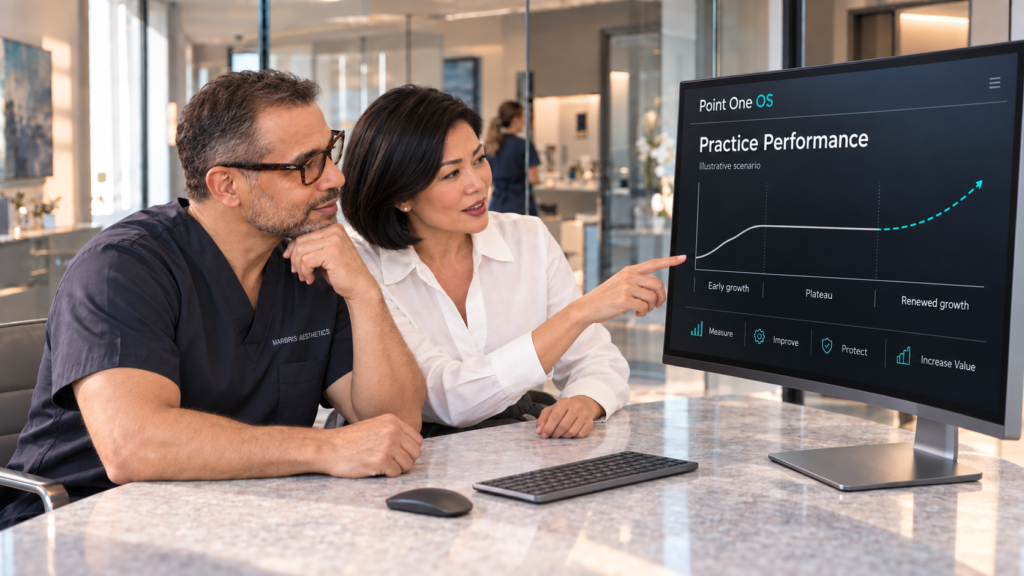

There is a meaningful difference between studying how an aesthetic practice operates and carrying the responsibility of actually running one. From the outside, a practice can appear relatively straightforward: marketing creates demand, consultations are scheduled, procedures are performed, revenue is generated and reports measure performance. On paper, it all looks quite orderly. Then the phone rings.
From inside the practice, the reality is considerably more complex. Every day involves interconnected decisions about people, patients, schedules, clinical workflows, revenue, compliance, training, staffing, inventory, follow-up and growth. Each decision may appear small in isolation. Together, they determine how consistently the practice performs and how resilient the business becomes.
Point One OS was built from that reality. Its foundation comes from decades spent inside medical aesthetics, including the operating environments of plastic surgery practices, the development and expansion of multi-location organizations, and the preparation of businesses for institutional investment. It also reflects the conversations that occur when private equity groups, investment bankers, surgeons and operators examine what truly makes a practice valuable. That experience shapes a fundamentally different view of practice growth.
Revenue Alone Does Not Build a Valuable Business
Revenue, growth and profitability matter. Revenue alone, however, does not explain the quality of the business producing it. Two practices can generate similar revenue while carrying very different levels of operational risk.
One may depend heavily on its founder, an experienced office manager, or a handful of employees who hold most of the institutional knowledge. Processes live in people’s heads, training varies by employee, and performance information is scattered across systems and spreadsheets. Important responsibilities get completed largely because someone remembers to complete them. “Ask the office manager” is a useful answer. It becomes a concern when it is the answer to everything.
The other practice may operate with defined standards, documented workflows, role-specific systems, measurable performance and structured accountability. Leadership can see emerging risks and address them before they become larger problems. Financially, the businesses may appear similar at first glance. Operationally, they are very different assets.
Point One OS was created around that distinction. The objective is to help practices build the operating infrastructure that makes performance more consistent, risk more visible and growth more repeatable. Producing more activity is only part of the equation; strengthening the business behind that activity is what creates lasting value.
The Best Systems Begin With the Real Problems
Point One began with operating problems familiar to anyone who has carried responsibility for a growing practice. What happens when an experienced office manager leaves? How quickly can a new patient care coordinator become effective? Can leadership identify weakening revenue performance before the monthly report arrives?
Other questions are equally consequential. Are critical credentials, compliance obligations and operational responsibilities visible in one place? Does every employee understand what excellent performance looks like in their role? Can the organization grow without increasing its dependence on a few exceptional people? These questions emerge from the daily realities of running aesthetic practices.
Technology can help address them, provided it serves a clear operational purpose. A dashboard may display information, a learning platform may provide training, an EMR may manage clinical records and scheduling, and a CRM may support patient communication. Each can be valuable; however, having these tools does not automatically create a coordinated way of operating.
An operating system connects standards, workflows, playbooks, training, tools, calculators, performance measures, accountability and intelligent guidance. It helps people understand what needs to happen, who owns the responsibility, how performance will be measured and where attention is required. The value lies in how those elements work together across the practice.
Systems Should Strengthen People, Not Replace Them
One of the most important lessons from operating inside aesthetic medicine is that great practices depend on human judgment, relationships and experience. Patients remember how they were treated. Teams respond to leadership. Office managers navigate situations that rarely fit neatly into a checklist, while patient care coordinators build trust during highly personal decisions. Front office teams influence a patient’s perception of the practice before the physician ever enters the room.
Systems should strengthen those contributions. Point One OS gives people the structure, clarity and support to perform at their best. The system strengthens the people. The people strengthen the practice. Together, they create lasting value.
That principle guides Point One’s approach to operational design. Talented people should spend less time searching for information, recreating processes, reacting to preventable problems or carrying knowledge that should belong to the organization. Clear standards and accessible resources give them a stronger foundation for making decisions while preserving the flexibility that real situations require.
When systems carry more of the operational burden, people can focus more effectively on work that requires judgment, leadership and human connection. In a field where trust and patient experience are essential, that is a meaningful operational advantage.
Turning Individual Excellence Into Organizational Capability
Many successful practices were built through extraordinary individual effort. A surgeon builds a reputation, an office manager learns how everything works, and a patient care coordinator develops an exceptional consultation process. A senior employee becomes the person everyone calls when something goes wrong. Those individuals create enormous value, and they can also become single points of dependency. Being indispensable is flattering. Being able to take an uninterrupted vacation is better.
The next stage of organizational maturity involves capturing what makes those people effective and turning those lessons into repeatable organizational capability. Their experience can inform documented operating standards, proprietary playbooks, defined workflows, structured onboarding and meaningful performance measures. In this way, individual expertise becomes a foundation others can learn from and build upon.
Over time, knowledge becomes less dependent on memory, performance becomes less dependent on heroics, and growth becomes less dependent on having exactly the right person in every seat at every moment. Experienced employees gain support, new employees gain direction, and leadership gains greater confidence in the organization’s ability to perform through change. That transition can materially improve the quality of a business.
Building a Practice With More Options
The value of stronger operating systems extends well beyond day-to-day efficiency. They create optionality. A surgeon may want to remain independent for the duration of a career, bring in a partner or recruit a younger surgeon. A growing group may want to open additional locations. An owner may eventually explore a partnership with private equity or a larger physician platform.
The future does not have to be decided today. What matters is building a business capable of supporting more than one future. That means reducing unnecessary dependency, improving visibility, creating consistency and developing systems that can continue performing as the organization becomes more complex.
Building lasting practice value begins long before any decision about ownership or succession. The same operational disciplines that support investment readiness can also make a practice easier to lead, more resilient through staffing changes and better equipped to grow on its owner’s terms.
Point One OS was built from inside that journey, with an understanding of the responsibility, complexity and opportunity involved. Better systems help good people perform more consistently, allow leaders to see more clearly and give owners greater confidence in the business they are building. The work of running the practice happens every day. The value comes from building a business that grows stronger because of it.